
Spondylolysis
What is Spondylolysis?
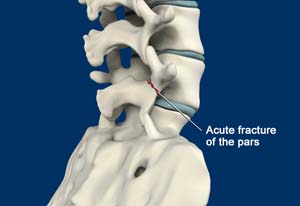
Spondylolysis is a stress fracture in the vertebra that may progress into spondylolisthesis, a condition where the vertebra gets displaced from the spinal column. Spondylolysis can be completely asymptomatic and found incidentally but it can be the cause of frequent low back pain in children, especially those who participate actively in sports such as football, weightlifting, and gymnastics.
Causes of Spondylolysis
Spondylolysis occurs because of a defect or stress fracture in the pars interarticularis, the part of the lumbar spine joining the upper and lower joints. Genetic factors may play a role. The common cause is repetitive trauma to the lower back area that occurs during sports and other activities can cause weakness of the pars interarticularis, resulting in spondylolysis. About 7-10% of the population have this condition. Furthermore, we do not see spondylolysis in mammals that walk on 4 legs; we only see it in people who stand and walk on two legs.
Symptoms of Spondylolysis
Although initially, your child may not have any symptoms, lower back pain is apparent during their teenage growth spurt period. The pain worsens with vigorous physical activities and exercises. At times, the pain may feel like a muscle strain. The back pain can progress to leg pain as spondylolisthesis occurs.
Diagnosis of Spondylolysis
Your surgeon diagnoses spondylolysis by reviewing your child’s family and medical history, performing a thorough physical examination and ordering imaging tests such as X-ray, CT scan or MRI scan.
Treatment of Spondylolysis
The primary treatment for spondylolysis is usually conservative. The goal of the conservative treatment is to reduce the pain, allow the fracture to heal and improve function. Conservative treatment options include:
- Rest: Adequate rest should be taken and strenuous exercises should be avoided until the symptoms subside.
- Medications: Non-steroidal anti-inflammatory drugs (NSAIDs) may be prescribed to reduce pain and inflammation. If NSAIDs do not provide relief, epidural steroid injections may be administered to the spine to reduce pain, numbness, and tingling in the legs.
- Physical therapy: An exercise program helps to strengthen the abdominal and back muscles, improve flexibility and increase range of motion of the lower back.
- Use of braces: In severe cases of spondylolysis, a brace or back support may be used to stabilize the lower back during fracture healing.
Surgery is usually required if spondylolysis progressed into spondylolisthesis or if non operative measures do not alleviate the pain. The goal of the surgery is to remove any abnormal bone compressing a nerve and to stabilize the spine.
A decompressive laminectomy and spinal fusion is a procedure in which a portion of the bone or lamina imparting pressure on the nerves is removed. A surgical incision is made in your back, and a part of the bone and thickened tissue pressing the spinal nerves is removed. This allows more space for the nerves thus relieving pain and pressure.
This procedure makes the spine unstable; therefore, spinal fusion is performed to stabilize the spine. Spinal fusion is the procedure of joining two adjacent vertebrae. During the procedure, a piece of bone removed from elsewhere in the body or donated from a bone bank is transplanted between the adjacent vertebrae. As healing occurs, the transplanted graft fuses with the vertebrae to stimulate the growth of a solid mass of bone, which helps to stabilize the spine. In some cases, metal implants such as rods, hooks, wires, plates or screws are used to hold the vertebrae firm until the new bone grows between them.
New treatment, however, includes endoscopic debridement of the fracture and repair of the fracture through endoscopic and navigation means.
- Posterior Lumbar Fusion
- Transforaminal Lumbar Interbody Fusion (TLIF)
- Extreme Lumbar Interbody Fusion (XLIF)
- Oblique Lumbar Interbody Fusion (OLIF)
- Image-Guided Spine Surgery
- Minimally Invasive Spine Surgery